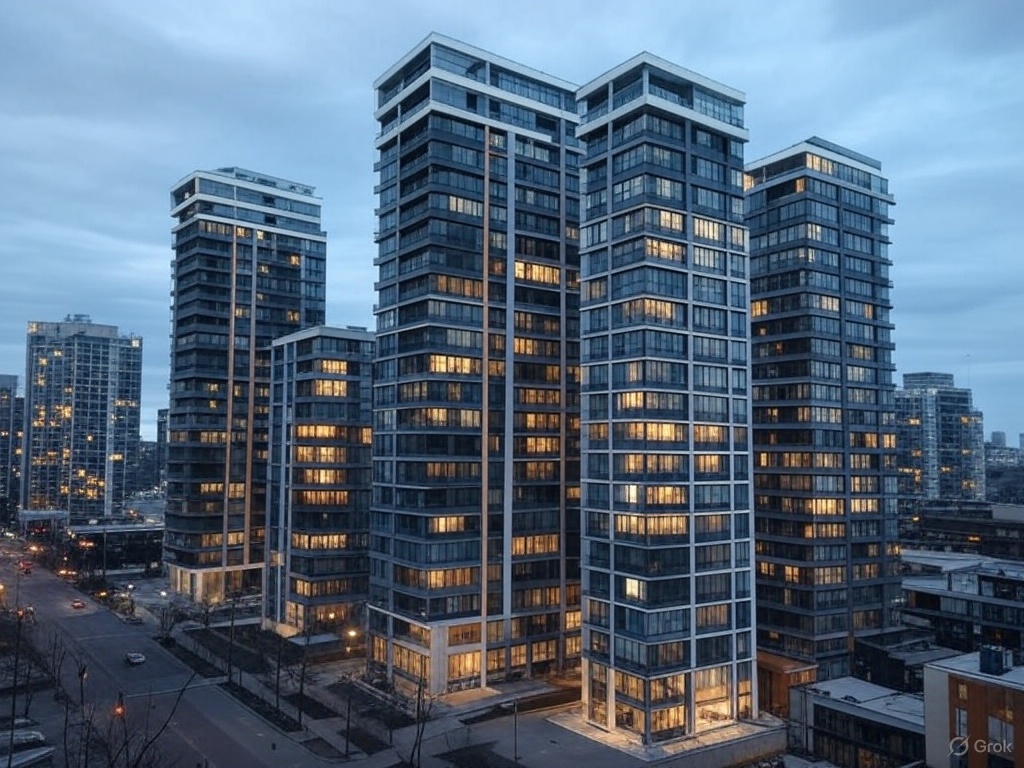
For years, Vancouver has held the crown as Canada’s most expensive real estate market, a city where sky-high prices and breathtaking views have defined its housing narrative. But as we step into 2025, a seismic shift is underway. Toronto, the bustling economic heart of Ontario, is poised to overtake its West Coast rival, driven by relentless demand, economic momentum, and a unique set of factors fueling its ascent. This isn’t just a story of numbers—it’s a tale of ambition, growth, and a city redefining its place on Canada’s housing map.
In early 2025, the average home price in the Greater Toronto Area (GTA) has surged past $1.4 million, inching closer to Vancouver’s $1.45 million benchmark. Analysts predict that by mid-year, Toronto could leap ahead, with projections pointing to a 7-10% price increase compared to Vancouver’s more modest 3-5% growth. The GTA’s rapid climb isn’t a fluke—it’s the result of years of population growth, corporate investment, and a housing supply that simply can’t keep pace with demand.
“Toronto’s market is on a trajectory we haven’t seen before. It’s not just about population—it’s about the type of buyers flooding in: high-income professionals and international investors who see the GTA as a global powerhouse,” says Sarah Mitchell, a senior analyst at Ontario Real Estate Insights.
Toronto’s rise isn’t happening in a vacuum. The city has become a magnet for talent and capital, fueled by its status as Canada’s financial hub and a growing tech ecosystem rivaling Silicon Valley. Companies like Google, Amazon, and Shopify have expanded their footprints here, bringing high-paying jobs and a wave of affluent buyers. Add to that a steady stream of immigrants—Ontario welcomed over 200,000 new residents in 2024 alone—and the pressure on housing is palpable.
Meanwhile, Vancouver’s market, while still pricey, has hit a plateau. Stricter foreign buyer taxes and a cooling luxury segment have tempered its growth, giving Toronto the edge it needs to pull ahead. In the GTA, condos, detached homes, and even suburban properties are seeing bidding wars reminiscent of the pandemic peak, a stark contrast to Vancouver’s more balanced market.
Ontario’s economic engine is firing on all cylinders. The province’s GDP growth outpaced British Columbia’s in 2024, bolstered by manufacturing, tech, and a rebounding service sector. Toronto, as the epicenter of this boom, is reaping the rewards. Interest rate cuts from the Bank of Canada, expected to continue into 2025, are also stoking demand, making mortgages more accessible and encouraging buyers to jump into the market.
“Vancouver’s had its moment, but Toronto’s economic fundamentals are unbeatable right now. Low rates, job growth, and a weaker Canadian dollar are drawing eyes—and wallets—to the GTA,” notes David Chen, an economist with Toronto Market Watch.
The weaker loonie has another effect: it’s attracting foreign investors who see Toronto as a bargain compared to U.S. cities like New York or San Francisco. A $1.4 million home in Toronto buys more than its equivalent in those markets, making the GTA a hotspot for international cash.
If demand is the spark, supply—or the lack of it—is the fuel keeping Toronto’s prices ablaze. Despite government promises to boost housing stock, construction in the GTA lags far behind need. In 2024, only 35,000 new units were completed across the region, a drop in the bucket against an estimated demand for 100,000 annually. Red tape, labor shortages, and soaring material costs have slowed progress, leaving buyers scrambling for what’s available.
Compare that to Vancouver, where a more mature condo market and proactive zoning reforms have eased some pressure. Toronto’s failure to keep up has created a perfect storm, pushing prices into uncharted territory and setting the stage for its 2025 takeover.
For prospective buyers, Toronto’s ascent is a double-edged sword. First-time homeowners face a steeper climb, with affordability slipping further out of reach. A typical GTA condo now costs over $800,000, while detached homes in desirable neighborhoods like Rosedale or Leaside routinely top $3 million. Yet, for those who can afford it, the market’s momentum suggests strong returns down the line.
Sellers, on the other hand, are in the driver’s seat. Listings in Toronto are moving fast, often with multiple offers, as buyers rush to lock in properties before prices climb higher. Investors, too, are doubling down, betting on the GTA’s long-term growth as Canada’s economic powerhouse.
Toronto overtaking Vancouver isn’t just a real estate headline—it’s a signal of shifting tides in Canada’s urban landscape. The GTA’s rise reflects its growing clout on the global stage, a city that’s outpacing its peers in ambition and opportunity. But it also raises questions about sustainability. Can Toronto maintain this pace without pricing out its middle class? Will Vancouver reclaim its throne with a surprise rebound? Only time will tell.
“This is more than a market flip—it’s a redefinition of Canada’s housing hierarchy. Toronto’s moment has arrived, but it comes with big challenges ahead,” warns Emily Harper, a real estate commentator based in Ontario.
As we move deeper into 2025, all eyes are on Toronto. The city’s trajectory suggests it’s not just catching up to Vancouver—it’s poised to redefine what “priciest” means in Canada’s real estate lexicon. Whether that’s a triumph or a warning depends on who’s watching. For now, one thing is clear: the GTA is the market to watch, and its reign may just be beginning.
